

The fascinating journey of heat, pressure, minerals, time and transformation behind the crystals we love.
If you have ever held a crystal in your hand, have you ever stopped to wonder where it came from?
Before it became your bracelet, your meditation stone or the crystal sitting beside your journal, where was it?
Most of us know a lot about our crystals. We know the name. We know the colour. We know the traditional meaning. We know how to cleanse it and how to wear it.
But very few of us know its first story.
And that story begins deep inside the Earth.
After many years of working with crystals, I have come to feel that if you love your crystal, you should know its journey too. So let me share it with you, the way I would if you were sitting right in front of me.
Before Your Crystal Reached You, It Belonged to the Earth
Natural crystals are not manufactured like ordinary objects. They develop through geological processes, slowly and quietly, far below our feet.
What are crystals?
In simple words, a crystal is a solid in which atoms are arranged in an organised, repeating pattern. Most of the crystals we love are minerals, which are naturally occurring solids with a specific chemical makeup and an ordered internal structure.

Imagine building with Lego blocks. If you throw them together randomly, you get a pile. But if the blocks keep repeating the same pattern, layer after layer, you get structure.
That organised, repeating structure is a big part of what makes a crystal a crystal.
I like to think of a crystal as nature's slow artwork. Instead of a painter working with a brush, the Earth works with minerals, temperature, pressure, fluids and time.
What Does a Crystal Actually Need to Form?
Different crystals need different conditions, but the basic ingredients are similar:
- The right elements. Every mineral has its own chemical recipe. Quartz, for example, is made of silicon and oxygen.
- The right temperature. Some minerals form from extremely hot environments, while others form in much cooler ones.
- The right pressure. Pressure affects which minerals are stable and how existing rocks change.
- The right environment. Crystals can grow in rocks, cavities, veins, sediments and other geological settings.
- Time. Growth can take very different amounts of time depending on where and how the crystal forms.
Change any one of these, and you can get a different mineral, a different size or a different look.
The Four Beautiful Ways Crystals Can Form
Geologists describe several ways minerals crystallise. Here are four of the easiest to understand.
|
Formation Process |
In Simple Words |
Examples |
|
Cooling of molten material |
Minerals crystallise as hot molten rock cools |
Quartz, feldspar, many igneous minerals |
|
Hydrothermal formation |
Hot, mineral-rich fluids move through rock and deposit minerals |
Quartz, tourmaline |
|
Metamorphic processes |
Existing rocks and minerals change under heat and pressure |
Garnet, quartz in some rocks |
|
Evaporation and precipitation |
Dissolved minerals crystallise as water conditions change |
Halite (rock salt), gypsum and other evaporite minerals |
Many minerals can form in more than one setting, so these examples are typical, not exclusive. Let me walk you through each one.
When Hot Material Cools: Crystals From Fire

Deep in the Earth, rock can melt into a hot, molten material called magma. When magma cools, minerals begin to crystallise out of it.
The cooling conditions matter a great deal:
- Slow cooling, usually deep underground, gives crystals more time to grow, so they can become larger.
- Fast cooling, such as at the surface, leaves less time, so crystals tend to be much smaller.
Quartz and feldspar are common minerals that crystallise this way, and they are found in rocks like granite. If the cooling is extremely fast, crystals may not form at all, which is how volcanic glass like obsidian is created.
So cooling speed influences which minerals form, how big they grow and what shape they take.
When Hot Water Carries Minerals Through Rock

Now imagine a hidden underground world.
Deep below the surface, hot water moves through cracks and spaces in rocks. As it travels, it dissolves minerals and carries them along. This is called hydrothermal formation, from the Greek words for "hot water."
What is hydrothermal crystal formation?
It is the process where hot, mineral-rich fluids deposit minerals as their temperature, pressure or chemistry changes. The dissolved minerals come out of the fluid and crystallise on the walls of cracks, veins and cavities.
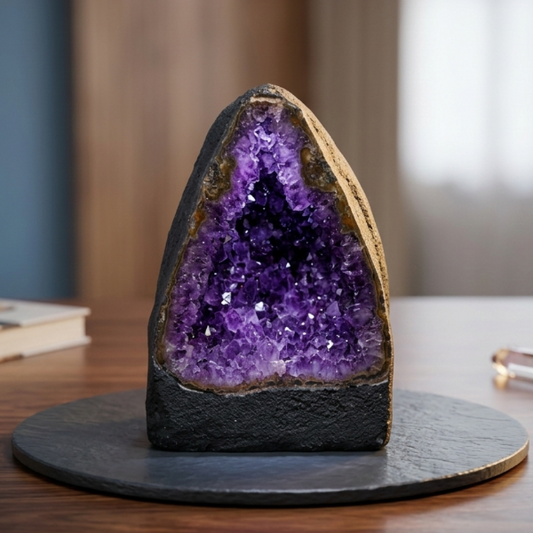
Quartz veins form this way. Tourmaline is often found in pegmatites and hydrothermal settings, where mineral-rich fluids are present in the late stages of rock formation. Many crystal-filled cavities, including amethyst geodes, are linked to mineral-rich fluids depositing quartz inside hollow spaces in rock.
When Heat and Pressure Transform Existing Rocks

Sometimes crystals do not form from scratch in molten rock. Instead, an existing rock is exposed to new conditions, such as deeper burial or nearby heat, without fully melting.
This is called metamorphism. Under higher heat and pressure, minerals can recrystallise, or entirely new minerals can grow.
Garnet is a lovely example. It commonly grows in metamorphic rocks as the original minerals react and rearrange themselves.
Think of it as the Earth giving an existing material a completely new set of conditions.
When Water Changes and Minerals Crystallise

This is the one you have already seen at home.
When salty water evaporates, salt crystals are left behind. Similar principles occur in nature. When water in lakes, seas or lagoons evaporates, dissolved minerals can become concentrated and crystallise. Halite (rock salt) and gypsum are common examples.
It is the same idea as your kitchen, only on a much larger scale.
How Long Does It Take to Make a Crystal?
How long does it take for a crystal to form?
There is no single answer.
Formation time depends on the mineral, the temperature, the pressure, how fluids move, which chemicals are available, the cooling rate, the geological setting and even how much space there is to grow.
Some crystal growth can happen under relatively rapid conditions. Many geological crystals develop over very long timescales, potentially thousands to millions of years or more, depending on the setting.
So, I never give a fixed number. Every crystal has its own geological clock.
The Earth Doesn't Make Perfect Crystals
Now we come to one of my favourite parts.
Natural crystals differ in many ways:
- Colour
- Clarity and cloudiness
- Inclusions
- Cracks
- Growth lines
- Shape and size
- Surface texture
Why do natural crystals have imperfections?
Because they grow in real, changing environments. Conditions can shift during growth, and rocks keep moving and changing long afterwards. These differences can reflect the conditions when the mineral formed or its later geological history.
This is something I want every crystal lover to understand: natural does not mean identical.
Why Is One Crystal Darker Than Another?
What makes crystals different colours? Colour depends on chemical composition, trace elements, impurities, structural defects and, in some minerals, natural radiation over time. Here are three well-known examples, and I will keep them honest, because not every specimen follows exactly the same path.
- Amethyst. Its purple colour is associated with iron impurities in quartz combined with natural irradiation. The depth of purple can vary a lot, even within one crystal.
- Rose quartz. Its pink colour is usually linked to trace elements or microscopic inclusions. Researchers are still studying the exact cause, and it may differ between specimens.
- Citrine. Its yellow to orange colour is linked to iron-related colour centres in quartz. Natural citrine is fairly rare. Much of the citrine sold in the market is heat-treated amethyst or smoky quartz, so it is always good to ask about the origin.
That last point is worth remembering. Colour can come from nature, and sometimes from treatment as well.
Those "Imperfections" Are Part of the Story
Inclusions, tiny fractures, veil-like cloudy patches, growth patterns and colour zoning can all be part of a crystal's natural formation history.
So, when you see a tiny line inside your crystal, don't immediately think something has gone wrong.
Sometimes you are simply looking at part of its story.
They are imperfect, but perfect in themselves.
Explore the crystal collection. If you would like to understand your crystals before choosing them, you can explore the collection on my website, where you can learn about different crystals and find pieces that suit your personal practice: shop.drneetikaushik.com
From a Rough Crystal to the One You Hold
After the Earth has done its work, human hands enter the story. The journey usually looks like this:
Earth, extraction, sorting, cleaning, cutting, polishing, shaping, and finally jewellery or product creation.
That is why crystals come in so many forms:
- Raw crystals: left in a natural or near-natural state
- Points and clusters: natural crystal growth, sometimes lightly cleaned
- Tumbled and polished stones: smoothed and shaped
- Beads and jewellery: cut and drilled for wearing
- Carvings: shaped into figures or objects
Here is the important distinction. The crystal may be natural, but the final form you buy may have been shaped by human hands. Knowing this is part of crystal literacy.
Why Your Crystal May Not Look Like the One in a Photograph
Have you ever received a crystal that looked slightly different from the photo? It happens to all of us.
Common reasons:
- Lighting: warm, cool or bright light changes how colour appears
- Camera settings: phones can boost or mute colours
- Natural colour variation: every stone is different
- Viewing angle: transparency and shine change as you turn it
- Inclusions: these can look very different in person
- Individual history: each piece grew under its own conditions
Two crystals of the same mineral can look noticeably different, and that is completely normal.
And This Is Where My Spiritual Understanding Begins
Everything I have shared so far is the story of the crystal through the language of geology. But as someone who has worked with crystals within spiritual practices, I also see another layer to their story.
This is where my understanding of crystals takes another turn, from geology to the way humans have traditionally understood and worked with these stones.
Across spiritual traditions and modern crystal-healing practices, different stones have been associated with:
- Intention and manifestation
- Meditation and emotional reflection
- Chakras
- Protection
- Abundance and love
- Grounding
These are symbolic and traditional associations. They are not geological properties, and I never present them that way. In modern crystal-healing literature, practitioners such as Judy Hall describe these associations in detail.
Why Do Crystal Practitioners Talk About Energy?
How are crystals used in spiritual practices? Practitioners often use crystals as:
- Energetic anchors to focus attention during practice
- Intention reminders placed on a desk, altar or journal
- Meditation companions held or kept nearby
- Ritual objects used in cleansing, charging and manifestation practices
- Symbols of personal transformation
This is a matter of belief and experience, and each person relates to it in their own way.
For me, there is something deeply meaningful about holding an object that has spent such a long time being shaped by the Earth. I see that as part of my spiritual practice, not as a scientific claim.
The Crystal Has Survived Conditions We Can Hardly Imagine
Think about what a crystal may have been through: intense heat, tremendous pressure, slow geological movement, chemical change and time beyond our ordinary sense of time.
Perhaps this is one reason I find crystals so meaningful in spiritual practice.
Practitioners may see a crystal as a symbolic reminder of:
- Resilience
- Patience
- Transformation
- Grounding
- Growth
To be clear, this is the spiritual interpretation. Within crystal-healing traditions, this extraordinary natural journey is one reason practitioners find these stones symbolically meaningful.
Learn the traditions, not just the names. If you don't want to simply buy crystals but actually understand them, take time to learn their traditional associations, how to care for them and the ways people use them in practice. You will find my crystal guides and resources on drneetikaushik.com. The crystals I offer are top-quality, high-vibrational and energized, so what you learn can go straight into your practice.
Every Crystal Is Unique Because Nature Doesn't Work Like a Factory
A factory repeats the same process again and again to get identical products.
Nature does not do that. Every crystal forms with its own mineral mix, temperature, pressure, growth conditions and geological history.
Nature never promised us identical crystals. It gave us individual ones.
What Your Crystal's Imperfections Can Teach You
This is my personal reflection, and it is a human one, not a scientific one.
I do not believe a crystal heals someone simply because it endured pressure. But when I look at a natural crystal with its inclusions and unevenness, I am reminded that growth does not always look polished.
We also carry experiences, scars, memories, changes and lessons. None of them automatically make us less beautiful.
Sometimes they are exactly what give us depth.
So, What Should You Notice the Next Time You Hold a Crystal?
Try this simple checklist:
- Look at its colour. Ask yourself what makes it unique.
- Look at its inclusions. Remember that natural crystals rarely look factory-perfect.
- Look at its shape. Is it raw, naturally formed, cut or polished?
- Think about its origin. It began as part of a geological process.
- Think about your intention. Why did you choose this crystal?
Choose with understanding. Don't choose a crystal only because it looks beautiful. Learn its story, understand how to care for it, and then decide how you want to work with it. You are welcome to explore the crystal section on my official website: shop.drneetikaushik.com
The Next Time You Hold Your Crystal, Remember Its Journey
Let us return to where we began.
Your crystal started deep inside the Earth. It formed through specific geological conditions. It experienced heat, pressure, fluids, cooling and time. It developed its colour and structure, and perhaps its inclusions and natural variations. It was eventually discovered, extracted, shaped and brought into human hands.
And now it sits with you.
The next time you hold your crystal, don't only think about what you want it to give you. Take a moment to appreciate what it already represents.
It carries a story of time, transformation and becoming.
We also experience pressure. We also change. We also go through phases we don't understand while we are living them.
And perhaps that is why crystals can feel so meaningful to people. Not because they replace our effort, but because they can become beautiful reminders of the transformation we are already going through.
Perhaps that is why I have come to appreciate natural crystals even more. Not because they are perfect, but because they remind me that beauty can emerge from pressure, change, patience and time.
Get to know their stories. If you love crystals, don't stop at knowing their names. Explore them, read about their traditional meanings, learn how to care for them, understand their different forms and choose them consciously. All the crystals on my website are top-quality, high-vibrational and energized, and each one is chosen with care: shop.drneetikaushik.com
The next time you hold your crystal, remember: before it became part of your story, it had already lived a story of its own.
Frequently Asked Questions
Q1. How are natural crystals formed?
Ans. Natural crystals form when atoms arrange into an ordered, repeating pattern during geological processes. These include cooling magma, hot mineral-rich fluids, heat and pressure changing existing rocks, and evaporating water leaving minerals behind.
Q2. Where do crystals come from?
Ans. Crystals come from the Earth's crust, where they grow in rocks, veins, cavities and sediments. They are then mined or collected, sorted, cleaned and sometimes cut or polished before reaching shops and buyers.
Q3. How long does it take for crystals to form?
Ans. There is no single timeframe. It depends on the mineral, temperature, pressure, fluids and setting. Some growth can be relatively rapid, while many geological crystals form over thousands to millions of years or longer.
Q4. Do all crystals form in the same way?
Ans. No. Some crystallise from cooling magma, some from hot fluids, some in metamorphic rocks and some through evaporation. A mineral like quartz can even form in more than one of these settings.
Q5. Why are some crystals clear while others are cloudy?
Ans. Clarity depends on growth conditions. Tiny inclusions, fractures, trapped fluids or structural irregularities can scatter light and make a crystal look cloudy, while steady growth can produce clearer material.
Q6. Why do natural crystals have cracks and inclusions?
Ans. Crystals grow in changing environments and are later affected by geological movement. Inclusions can be other minerals or fluids trapped during growth, and fractures can develop over time or during extraction.
Q7. Why are crystals different colours?
Ans. Colour comes from chemical composition, trace elements, impurities, structural defects and sometimes natural radiation. Amethyst, for example, owes its purple to iron impurities in quartz combined with irradiation.
Q8. Can heat and pressure affect crystal formation?
Ans. Yes. Heat and pressure influence which minerals are stable, how fast they grow and how existing minerals recrystallise. Metamorphic minerals like garnet form under these conditions.
Q9. Why are no two natural crystals exactly alike?
Ans. Each crystal grows with its own mix of elements, temperature, pressure, space and time. Those small differences make every natural crystal unique in colour, shape and internal features.
Q10. Why are crystals used in spiritual practices?
Ans. In crystal-healing traditions, practitioners use crystals as symbols and focus points for intention, meditation, grounding and reflection. These are traditional and personal beliefs, not scientific findings.
References and Sources
A. Geological and scientific references (used for formation, structure, colour and inclusions)
- U.S. Geological Survey (USGS), educational resources on minerals, rocks and the rock cycle: usgs.gov
- National Park Service, Geology and Geologic Processes resources: nps.gov/subjects/geology
- Smithsonian National Museum of Natural History, Department of Mineral Sciences and Gem & Mineral collection: naturalhistory.si.edu
- Gemological Institute of America (GIA), gem and mineral education, including the causes of colour in quartz varieties and gem treatments: gia.edu
- Mineralogical Society of America, mineral science resources: minsocam.org
B. Crystal-healing and spiritual references (used only for traditional associations, not as scientific evidence)
- Judy Hall, The Crystal Bible
- Judy Hall, The Encyclopedia of Crystals
Note for editing: please check the exact page or article on each site before adding direct links, so every link goes to a live and correct page.













1 comment
Captivating narration about the formation of crystals, their colours and various shapes.